Why I Start with the Ontology
This site is my public workspace for building ontology-driven systems in the open.
The starting point of my engineering philosophy is simple: data products become trustworthy only when their concepts, constraints, provenance, and validation rules are explicit.
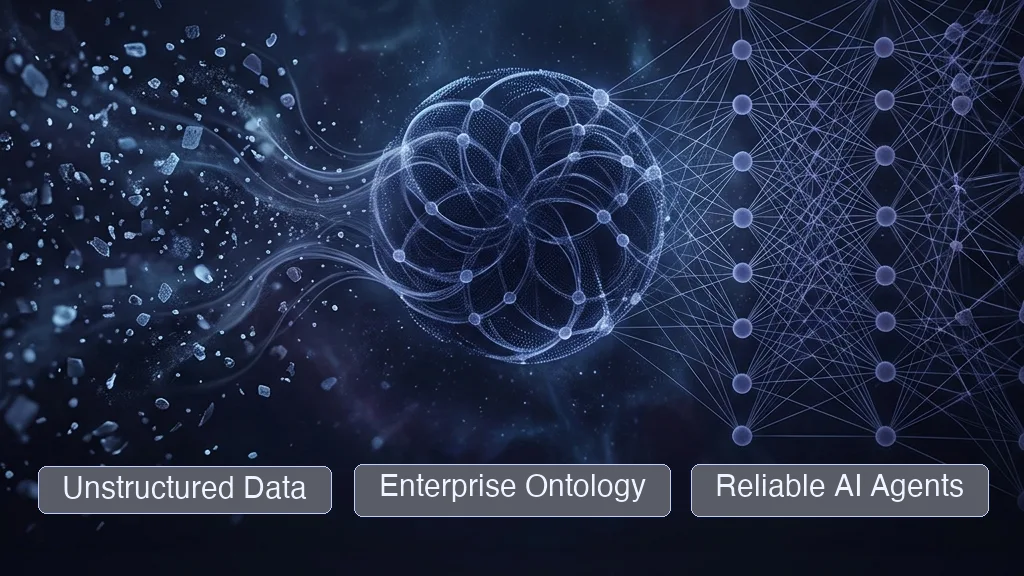
For the last decade, the data industry worshipped at the altar of the “Data Lake” and “Schema-on-Read.” We dumped raw, unstructured data into cloud buckets and told analysts they could figure out what a Customer or a Transaction meant later. The result was predictable: isolated data swamps, duplicated definitions, and a total collapse of trust.
The Era of LLMs Demands Ontologies
The arrival of Large Language Models (LLMs) accelerated this crisis. An LLM is a probabilistic engine; it predicts the next most likely token. It does not “know” things. It does not understand your business logic.
If you point a raw LLM at a data lake, you get a hallucination engine.
To build safe, production-grade AI - whether that is a GraphRAG application answering supply chain questions or an Agent autonomously executing tasks - you must ground the probabilistic model in a deterministic foundation.
That foundation is the Ontology.
An ontology is a machine-readable representation of your domain. It uses W3C standards (RDF, OWL, SHACL) to define exactly what entities exist, how they relate, and the strict rules governing them. When an LLM drafts a SPARQL query or proposes a new fact, the ontology is the fixed vocabulary and rulebook it must answer to: terms that don’t exist are rejected, relationships the schema forbids never validate, and violations are caught deterministically instead of discovered in production. The reasoning engine enforces the laws of physics for your business domain.
The Roadmap
Everything on this site builds toward that deterministic foundation - in roughly the order you’d actually build it:
- Engineer the ontology. The Agile Ontology Engineering series treats an ontology as a versioned software product: from requirements and competency questions to OWL, continuous SHACL validation in CI/CD, and semantic-versioned releases with persistent IRIs.
- Fill it - at scale, and over time. Provenance-stamped semantic ingestion, an entity-linking flywheel, and temporal context so the graph knows not just what is true, but when.
- Let AI use it safely. GraphRAG and SHACL-gated agent writes, so language models read and propose against the graph while shapes decide what is allowed to land.
- Make it usable. Hands-on tools - an Ontology Explorer for navigating a schema, and nl2sparql, which turns plain-English questions into SPARQL grounded in an ontology’s real vocabulary.
Start with the ontology, and everything above it inherits its trust.